Why Didn’t Police Tackle Him? The Reality Behind Dallas Bridge Stand-Offs.
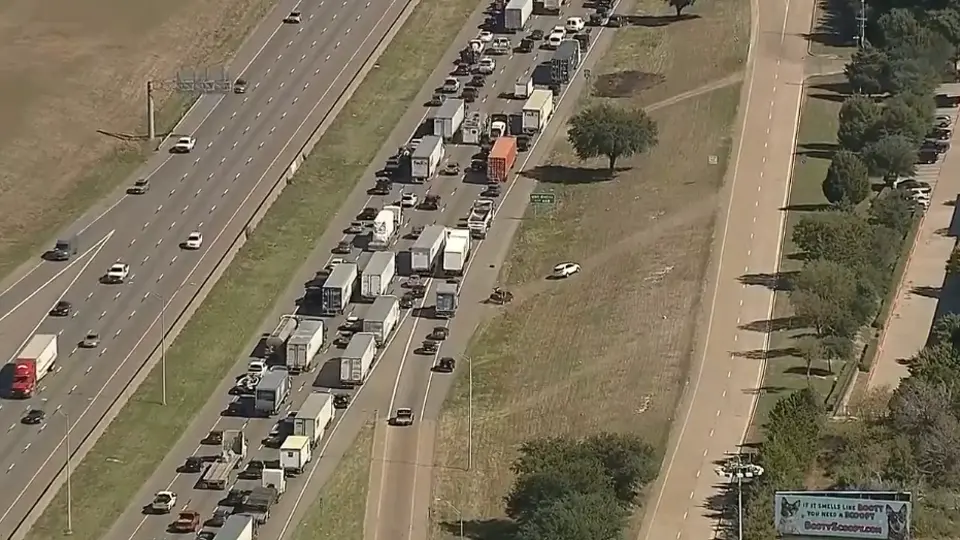
Earlier today, lanes along the Interstate 45 and Interstate 20 interchange in southern Dallas were shut down for hours while Dallas police attempted to help an individual on an overpass. Tragically, the standoff ended with the individual jumping.
Whenever an incident like this happens, the same questions immediately flood social media:
- *"Why did they just stand there for hours?"
- "Why didn’t an officer sneak up and tackle him?"
- "Why didn't they Taser him or put a giant stunt net underneath?"
It is natural to ask those questions. Seeing someone on a ledge while officers stand 30 feet back can look like hesitation. But in elevated crisis situations, charging an unanchored person on a bridge is almost never done.
Here is how the rules, the law, and basic physics actually work in these moments.
- It Comes Down to Simple Physics and Panic
The biggest question people ask is: Why didn't an officer just sprint forward and grab him?
Action beats reaction: An officer standing 15 to 20 feet away has to overcome inertia, sprint across open pavement, and secure a tackle. The person on the ledge only has to relax their grip, lean forward, or take a single step. Rushing toward someone in an acute crisis almost always triggers an immediate leap before an officer can close the gap.
Sensory overload: People in an acute mental health crisis experience severe tunnel vision and adrenaline surges. When uniforms suddenly charge them, fight-or-flight kicks in. They perceive it as an attack and jump to escape.
Rescuers can go over, too: Without technical fall-arrest harnesses, a physical struggle on a narrow bridge ledge carries an extreme risk of dragging the officer over the side along with the subject. The rare times you see police pull someone off a bridge, the person was already within arm's reach and officers had complete physical leverage.
2. Why Tasers and Pepper Spray Are Off the Table
People often ask why police don't just use a "less-lethal" tool like a Taser to freeze the person in place.
Tasers cause full muscle lock-up: A Taser works through neuromuscular incapacitation. If someone is perched on a highway railing and their muscles lock up, they lose all grip and immediately fall to the road below.
DPD General Order 900: Dallas Police Department General Order 900 specifically bans Tasers in situations like this. The policy explicitly states that officers cannot use a conducted energy weapon "when the subject is in an elevated position where a fall may cause serious injury or death". Firing a Taser on a bridge converts an intermediate tool into deadly force.
Pepper spray is just as dangerous: Chemical agents cause severe burning, coughing, and involuntary eye closure. Spraying someone on a ledge almost guarantees they lose spatial awareness and stumble off.
- What Texas Law Says About Protective Force
Police have statutory authority to intervene, but that authority has strict boundaries:
Texas Health and Safety Code § 573.001: Officers can take someone into custody without a warrant if they have reason to believe the person is mentally ill and presents a substantial, immediate risk of serious harm to themselves. This is protective custody for psychiatric care, not an arrest for a crime.
Texas Penal Code § 9.34(a): Under Texas law, a person is legally justified in using force to prevent another from committing suicide or inflicting serious bodily injury on themselves. However, the statute explicitly allows force "but not deadly force".
If an officer initiates an uncontrolled tackle on an open overpass ledge that results in the person falling, that action can be legally interpreted as deadly force, violating state law and departmental policy.
4. Why Standoffs Take Hours (and Why That’s the Goal)
When Dallas police respond to a bridge call, their primary tool is time, not force.
Traffic shutdown: Highways are closed in both directions. Officers shut down the bridge deck to clear civilian onlookers, prevent heckling, and reduce sensory overload. They shut down the highway lanes below to prevent passing traffic from striking anyone or causing secondary multi-car collisions.
**
Bringing in specialized teams: **Patrol officers maintain containment and call in specialists. In Dallas, that includes the RIGHT Care team (which pairs a DPD officer with a paramedic and a licensed mental health clinician) along with certified negotiators from DPD's Crisis Negotiation Team (CNT) and Tactical Section (SWAT).
Letting adrenaline decline: Acute psychiatric crises involve massive adrenaline spikes. Negotiators intentionally extend the interaction because the human body cannot maintain peak fight-or-flight indefinitely. As time passes, physiological arousal drops, and individuals become far more receptive to rational dialogue and stepping back to safety.
5. Why Don’t They Use Giant Nets or Air Cushions?While air cushions are used by fire departments in structural rescues, they are impractical for highway flyovers:
Height limits: Standard fire rescue cushions are rated for drops of roughly 30 to 45 feet. Major freeway interchange ramps—such as I-45 and I-20—are often 60 to 90 feet high. Hitting a cushion from that height exceeds equipment tolerances, causing fatal impact trauma.
**
Trajectory control:** A falling person cannot be steered. If an individual pushes outward, they easily miss a cushion positioned directly beneath the bridge.
Setup commotion: Dragging heavy blowers, generators, and industrial pads directly beneath an overpass creates significant noise and commotion, which frequently triggers a jump before equipment is fully inflated.
The Bottom LineWhen an elevated crisis ends in death, it is a tragedy of acute mental distress. Officers standing at a distance are not doing nothing; they are following established protocols designed to avoid provoking an immediate leap.
Rushing a ledge or deploying intermediate weapons turns a critical negotiation into an immediate fatal fall. Slowing the scene down, securing the area, and keeping communication open remains the only strategy that offers a distressed person a real chance to step back alive.
By RicoTv